When Should Entertainment Happen During a Corporate Dinner?
Where the show belongs in the run of show — around cocktails, courses, speeches, awards, and dessert.
By Tres Miller · July 19, 2026 · 6 min read
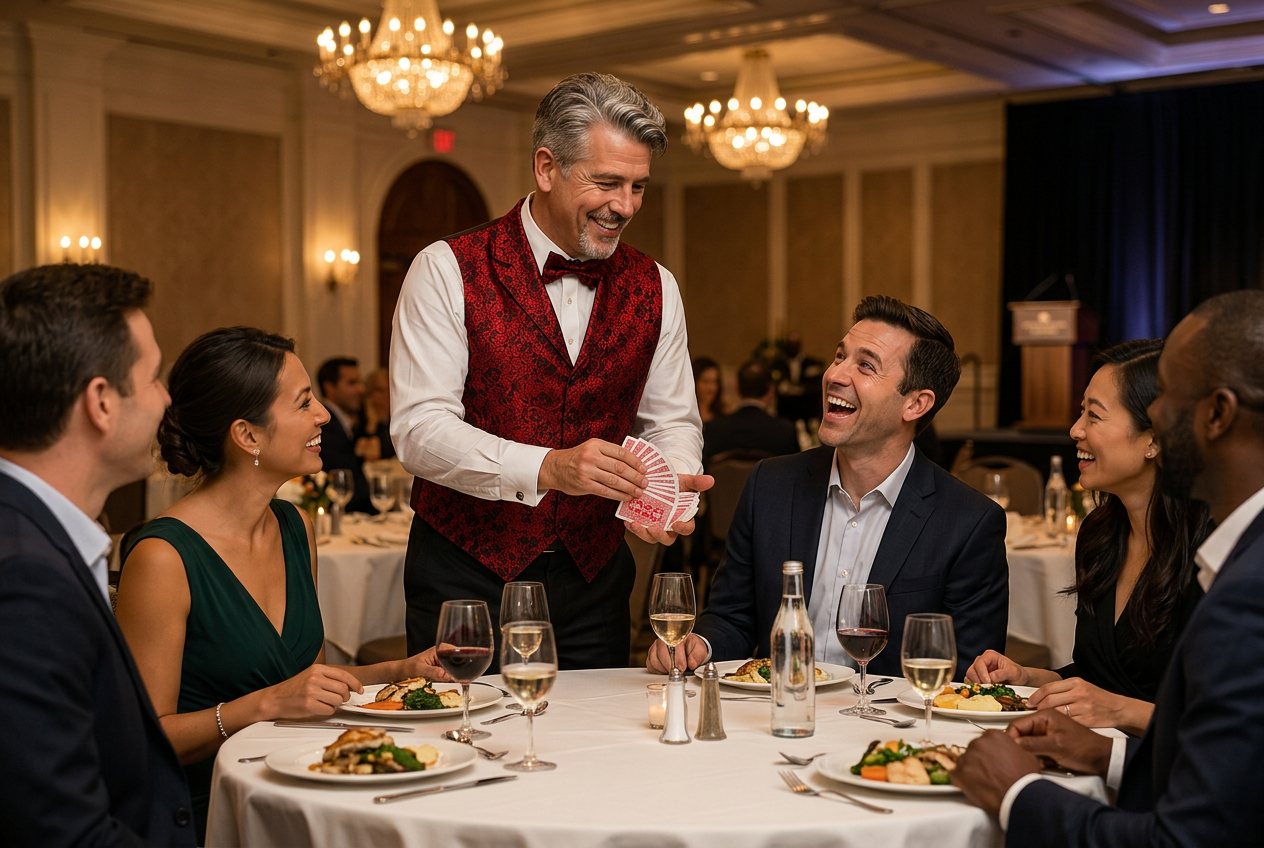
When should entertainment happen during a corporate dinner?
For most corporate dinners, the strongest options are strolling magic during the cocktail hour and arrival period, and a featured show after dinner service is finished but before or immediately after awards. Entertainment placed between courses interrupts catering, and entertainment placed after a long awards block often loses the room. The best time is the window where guests are seated, fed, and not waiting on staff, speeches, or plates.
- Strolling magic fits the arrival and cocktail window better than any other slot.
- A featured show works best after the main course is cleared.
- Never schedule entertainment to compete with awards, speeches, or plated service.
- Build the timing with catering and AV, not around them.
- Thirty to forty-five minutes is usually enough for an after-dinner set.
Corporate dinners fail for timing reasons far more often than for content reasons. The food can be excellent, the venue beautiful, and the entertainment strong — and the evening still feels choppy because two things were scheduled on top of each other. Guests can only give their attention to one thing at a time, and a dinner already asks for a lot of it: finding a seat, meeting tablemates, eating, listening to leadership, and applauding coworkers.
So the real question is not whether to include entertainment. It is where the entertainment goes so that everything else in the schedule still works.
The Four Windows in a Corporate Dinner
Almost every company dinner has the same four natural windows. Each one supports a different kind of entertainment.
- Arrival and cocktail hour: Guests are standing, mingling, and often waiting for the room to open. This is the strongest window for strolling close-up magic, because it fills dead time instead of competing with anything.
- Dinner service: Protect this window. Servers need aisles, and guests want to eat and talk. Light background entertainment can work; a featured show cannot.
- After the main course: The best slot for a featured comedy magic show. Plates are cleared, everyone is already facing the room, and energy is ready to be lifted.
- Dessert and open networking: A good place for a second strolling pass or for nothing at all. Some evenings simply need a soft landing.
Before Dinner: Strolling Magic Earns Its Keep
The cocktail hour is the most underused part of most corporate dinners. Guests arrive at slightly different times, some know nobody in the room, and the host is usually managing check-in rather than working the crowd. Strolling magic solves that quietly. Small groups form around short pieces of close-up magic, strangers end up reacting to the same moment, and conversation starts on its own.
This window is also forgiving. If a group is deep in a business conversation, a strolling performer moves on. Nothing in the schedule breaks.
Between Courses: Usually a Mistake
Placing a show between courses looks tidy on a timeline and rarely holds up in the room. The catering team is working to a plan, and a 25-minute performance gap changes when food leaves the kitchen. Meanwhile, guests who see servers waiting at the edge of the room start watching the servers instead of the show.
If a between-course slot is unavoidable, it needs an explicit agreement with the catering lead: a protected gap with a defined start and end, and no service during it. Without that agreement, move the show later.
After Dinner: The Featured Show Slot
Once the main course is cleared, the room is at its best for a shared moment. Everyone is seated, sightlines are already set, and there is no competing activity. A 30–45 minute set here gives the dinner a centerpiece without stretching the night.
There is also a practical benefit for the host. A show right after dinner warms up the room before recognition and awards, so applause is louder and the audience is already engaged rather than waiting for the evening to begin.
Awards and Speeches: Give Them Their Own Space
Awards deserve the same protection as the entertainment. If a magic show and an awards block run back to back with no transition, both feel rushed. A short break, a change in lighting, or a simple handoff from the emcee gives the room a signal that something different is starting.
One order that works consistently for company dinners:
- Arrival and cocktail hour with strolling magic
- Welcome from the host, then dinner service
- Featured comedy magic show after the main course
- Awards, recognition, and executive remarks
- Dessert, coffee, and open networking
Write the run of show backward from the moment you most want guests to remember. If that moment is an award presentation, schedule the entertainment to build toward it. If the goal is a relaxed, connected evening, put the magic where the room is fullest and quietest. Everything else on the timeline is logistics.
Coordinating With Catering and AV
Timing decisions live or die on coordination. A few short conversations prevent almost every scheduling problem:
- Catering lead: When does each course go out, and when will service pause?
- AV contact: Is a wireless handheld microphone available, and can house music be muted on cue?
- Venue: What are the load-in access, parking, and lighting options for the performance window?
- Emcee or host: Who introduces the show, and what should they say?
- Room layout: Where will the performer work so every table has a sightline?
Common Timing Mistakes
- Starting the show while food is still arriving. The performance competes with plates and loses.
- Scheduling entertainment after a long awards block. By then, guests are checking phones and coats.
- Booking a featured show for a room built for mingling. An open-house layout wants strolling magic instead.
- Leaving the cocktail hour empty. That hour sets the tone for the whole evening.
- Not telling the performer the real timeline. A show planned for 45 minutes and cut to 20 on the night helps nobody.
Frequently Asked Questions
When should entertainment happen during a corporate dinner?
For most corporate dinners, the strongest options are strolling magic during the cocktail hour and arrival period, and a featured show after dinner service is finished but before or immediately after awards. Entertainment placed between courses interrupts catering, and entertainment placed after a long awards block often loses the room. The best time is the window where guests are seated, fed, and not waiting on staff, speeches, or plates.
Should entertainment happen before or after dinner?
Before dinner works well for strolling magic while guests arrive, find their tables, and get drinks. A featured show usually lands better after the main course, when guests are relaxed, servers are clearing rather than delivering, and nobody is watching the kitchen door.
Can a magician perform between courses?
It is possible but rarely ideal. Servers need clear aisles and predictable timing, and a set interrupted by plates arriving loses momentum. If the catering team can guarantee a protected 20-30 minute gap, a short set between courses can work; otherwise place the show after the meal.
How does entertainment fit around awards and speeches?
Keep them separate. Awards, recognition, and executive remarks need the room's full attention, and so does a show. A common order that works is arrival strolling magic, dinner, a featured comedy magic set to warm the room, then awards, then dessert and open networking.
How long should the entertainment segment be at a corporate dinner?
Thirty to forty-five minutes is enough for a featured after-dinner show at most company dinners. Strolling magic during a cocktail hour typically runs 60-120 minutes so the performer can reach every table or group without asking guests to stop what they are doing.
What does the venue and catering team need to know in advance?
Share the run of show with the venue, catering lead, and AV contact: entertainment start and end times, whether a microphone is needed, when service must pause, house lighting for the segment, and where the performer will work. Confirming those details early prevents a show from starting while entrees are still going out.
Corporate Dinners Across Utah
Company dinners in Utah County, Salt Lake County, and Davis County — Orem, Provo, Lehi, American Fork, Spanish Fork, Salt Lake City, Bountiful, and Layton — happen in hotel ballrooms, event centers, restaurants, and company facilities. Each venue has its own service rhythm, so the timing that works at one location may need a small adjustment at another. Sharing the room layout and catering plan early is the fastest way to get the entertainment window right.
Related Reading
- How Much Corporate Entertainment Is Enough for a Company Event?
- Strolling Magic vs. Stage Magic
- Close-Up Magic for Corporate Events
- Holiday Party Magic: The Secret to Guest Engagement
- The Best Entertainment for Company Parties When People Don't Know Each Other
About the Author
Tres Miller performs as Tres the Great throughout Utah. He became interested in magic around age eight, began performing paid shows around age twelve, and worked with MAGIZMOS from roughly 1991 to 1998 demonstrating, selling, and teaching magic. His work today includes corporate events, holiday parties, birthday parties, school assemblies, library programs, festivals, city celebrations, and private magic lessons. Read more on the bio page.
Plan entertainment that gets guests talking. Review show options and pricing, then check corporate availability.
Check Corporate Availability